
The Sound of Regret
DA Colm Truesdale Book 2
Trey Gowdy and Christopher Greyson
Harper Influence Pub
August 2025
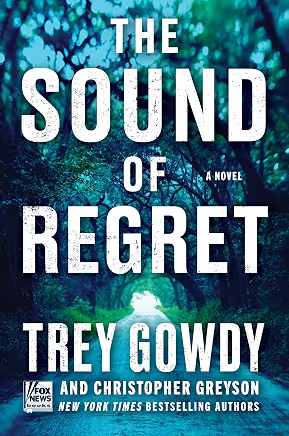
The Sound of Regret by Trey Gowdy and Christopher Greyson is a dark, atmospheric thriller.
The plot has the main character, Assistant District Attorney Colm Truesdale vowing to hunt down the killer of a confidential informant, but a prosecution witness is murdered. As he dives into the investigation, a far more dangerous threat emerges: a ghost from his past, a highly motivated psychopath who has spent years spinning an invisible web designed to destroy him. Every lead Colm pursues draws him deeper into the trap, blurring the line between hunter and hunted.
With his career, his freedom, and perhaps his very life hanging in the balance, Colm must outmaneuver a mind as ruthless as his own, plunging deeper into the twisted psychology of a ruthless killer and into the heart of the relentless prosecutor determined to bring him down.
Elise Cooper: Idea for the story?
Trey Gowdy: That story had been rattling around in the catacombs of my mind for about a decade. It was going to remain there until my boss, Suzanne Scott, the CEO of Fox, brought me into her office. I thought she wanted to talk about the Murdaugh trial, but then she just asked, if I ever thought about writing fiction. I had written three nonfiction books at that point. Sitting in church services, letting my mind wander, that’s where I kind of wrote it.
EC: Why did you make this book a cliffhanger?
TG: It was not intentional, because it was all one book to me, but nobody wants to read War and Peace part two. It would have been lengthy. This is really 3 books, not one. There were loose ends in book one, there are loose ends in book two. Everything will be tied up in book 3, but what I tell folks that ask me, ‘how could you do that to me? Why did you do that to me?’ In my head, it was all one book.
EC: What about the plots between book?
TG: The first book, if I had to characterize it, I would say it is the relationship between prosecutors and cops and victims of crime, which is a relationship that’s very hard to describe unless you have lived it and experienced it. They are trusting you through what is the worst experience of their life, if they live, and their family and friends are trusting you. Along with a little of a critique on the so-called world of drugs, which, when I was in federal prosecutor, most of my cases were drug cases. In this book the plotline was in the first chapter or so where I had the trial. I started both books off with a courtroom scene. Just because this is a book about a prosecutor, so I want the reader to know the prosecutor knows what he or she is doing. The particular murder, the man who was tried for killing his wife, I did prosecute a case very similar to that, but that’s kind of a head fake. The real story was the informant’s body that was found at Lake Saranac.
EC: Any truth to it?
TG: I had a witness killed but not at Lake Saranac. Readers should understand that Saranac is a very small lake in my hometown, that very few people know about. But, yes, I had a witness killed. In fact, the book is dedicated to a young man named Ricky Tyrone Samuel and to his mother. And, when I was a Fed, I sat down and had the same conversation with the rookie criminal that I had with scores of young men which is, you can cooperate with us. Maybe wear a wire, certainly not going to be a rat or a snitch. They’re not angry conversations, but they’re frank. I mean, I told many a young man you’ll be my age when you get out.
EC: Do you think judges through their instructions can influence trials?
TG: The simple words, overruled or sustained, or whether you allow certain exhibits, yeah. But the prosecutor also has a responsibility, to not try things that they know are close, and they can’t be testing the judge all the time, or else they’ll be retrying the case. I wish I had a nickel for every judge who told me, ‘I think you have enough.’ I have a lot of respect for judges, many of my friends now have become judges. It’s a hard job to do but their rulings can influence. I wouldn’t say intentionally but yes, their decision on whether to allow for certain acts, whether to allow certain questions, or how much leeway to allow. It seems to me that even more recently, I guess, the judges aren’t the unbiased kind of mediator, but they’re inserting their whatever into the courtroom. I want the reader to know that the judge in the story confused himself with God. But he also was an awful, crooked judge, and I never ran into any of those. Judges that sound, or write, like, politicians, make the news. I think with cameras everyone acts differently when there’s a camera around.
EC: The other sub-plot has the Prosecutor Colm being framed?
TG: The person who is framing Colm did not believe their daughter, but was going after Colm. Yet, the defendants that I put in prison for drug cases were treated with respect. They did their time, they’re out, they know they did wrong. They’re not coming back to get me or carry a grudge.
EC: How would you describe the law student, Belle?
TG: She’s a light in an otherwise dark world. There is a very high toll when someone works in a criminal justice system because it is a dark world. The pictures you can’t get out of your mind of crime scenes. When I told my mom and my wife that I was writing a fiction book, the only thing they asked me to do was to have a little bit of light in the book, and the light is Belle. The question will be whether she remains as she is, which is innocent and pure, or whether the system corrupts her. I would say that Belle is kind, innocent, and sweet. Belle is my wife, modeled after my wife, except my wife is not a woman of color, and my wife is not 23 years old. But in terms of the characteristics, how they treat people, she has my wife’s personality.
EC: How would you describe JD?
TG: Smart, relentless, and, utterly devoid of any of the social norms that we need for a functioning society. She is the mother of a daughter that was sexually abused, and did not believe her daughter. I tried to research that phenomenon because I saw it more often than I thought I would see. I did read some articles on why mothers choose to stay with an abusive boyfriend or father. So, JD is diabolical, but she’s also smart. I mean, nobody’s afraid of a dumb criminal. I guess, the best way to describe her if you’re into psychology, she has the dark personality.
EC: What about the Innocence Project?
TG: True. A worthy defendant or inmate is identified to see if they are not guilty. My daughter is a public defender; both of my kids are lawyers. I put people in jail and her life mission is to get them all out. So, yeah, it is true that there is something called the Innocence Project. There’s also something called Justice 360. I wanted to set the table for book three, where Belle is trying to clear someone who really doesn’t have a conviction.
EC: Next book?
TG: Belle kind of inadvertently falls into that by trying to clear this man who took his life when he was arrested. The working title is The Loss of Grace. Right now, there’s not a firm publishing date. We did the first in the summer of 2025. We did the second in the summer of 2026, so I don’t think it’d be unreasonable to expect it in somewhere 2027.
THANK YOU!!