

Sisters In Death: The Black Dahlia, The Prairie Heiress, and Their Hunter by Eli Frankel
Kensington Press/October 28, 2025
Eli Frankel’s meticulously researched true crime endeavor claims to answer the question that has eluded authorities for nearly eighty years: who killed the Black Dahlia?
We all know the story, or at least parts of it. Elizabeth Short, a young woman desperate for Hollywood fame was found nearly bisected in an undeveloped lot in Los Angeles, her body drained of blood. The gruesome murder captivated the nation, with police chasing down lead after lead until the case went cold forever. Since then, the story goes, Elizabeth Short attained what she hadn’t in life– fame through pop culture depiction and true crime enthusiast fixation.
In Sisters In Death: The Black Dahlia, the Prairie Heiress, and Their Hunter, Frankel delivers justice to Short by not only identifying her killer and providing solid reasoning in support, but also by drawing from dozens of sources to paint a portrait of who she really was. Short was not an aspiring actress, eager for the limelight, but a lonely and naïve young girl out of her depth in the gritty underbelly of Los Angeles. Enticed to the area by her father–who had crawled out of the woodwork after faking his own death years before–Short spent her limited time there searching for love and stability rather than movie roles. Frankel doesn’t try to glamorize Short as others have but paints a realistic depiction of a girl who may have eventually found her footing but whose life was cut short before she could do so.
Then, Frankel does the same for Leila Walsh, a name unfamiliar to most. The opposite of Short, Walsh was a popular, wealthy college graduate with solid social footing and a loving family. Had she lived, Walsh would have spent her life teaching young children. Frankel’s hypothesis as to Short’s killer hinges on Walsh’s similarly horrific murder that occurred in Kansas City six years prior. Frankel details the “perfection” that was Walsh before she was so brutally killed, her swearing off marriage despite being hotly pursued by many men. In the aftermath of her murder, her own grieving brother was put on trial for her death. When he was exonerated, no other viable suspects were found.
Frankel’s book is divided into three segments: one devoted to Walsh’s life and up to her murder, another on Short, and the last identifying his proposed killer and laying out the evidence. This last portion is utterly engrossing not only because it seems that Frankel is right on the mark, but also because it highlights the limitations of the time. Had these young women’s killer struck in 2025, DNA evidence and security cameras would have led to the individual being behind bars before the night was through. As it was, numerous opportunities to nab the depraved killer simply did not exist. The police in Los Angeles couldn’t even get copies of Walsh’s records from Kansas City.
Frankel doesn’t miss a detail here. He seems to have interviewed everyone, to have consulted every source. The result is that he ends up not only convincing us of the identity of the killer but also brings his two victims to life once again. There’s an accuracy to their portrayals which has never been shown to the masses. This is particularly true of Short, who has always been sensationalized. Frankel’s book makes her into a real, flesh and blood woman, someone fallible and imperfect and whose life and death were more than as they were portrayed in the headlines that sold so many newspapers.
For fans of true crime fiction and particularly those captivated by the story of the Black Dahlia, this one is a must.
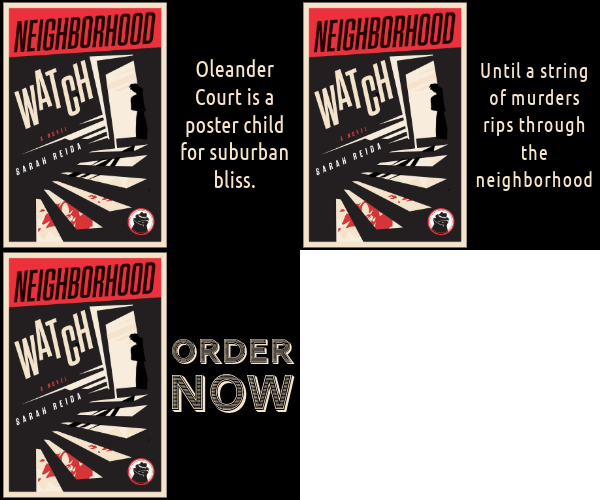
Sarah Reida only reviews books she overall recommends. A writer of dark comedy thrillers, she is in the process of revising her sophomore novel. Her debut, Neighborhood Watch, received a Kirkus Star and was honored as an Amazon editorial pick as one of the Best Books of the Year So Far 2024. Join Sarah’s elite group of Instagram followers here.